Posts

But why can't you just fix my tooth ?

Image
  Patients often come into the NY University School of Dentistry where I teach to treat their dental emergencies. They often have a particular symptom that is bothering them. The students often want to address the symptom immediately, but often they are required, in non emergency situations, to first do a comprehensive exam and treatment plan.  It is not usual for these new patients at the school to initially express a resistance to taking a full set of radiographs and submitting to a full work up by their student. Often their student also wants to immediately care for the tooth thats bothering them, but our student dentists need to understand the importance of  performing a complete patient assessment prior to performing non emergency dental treatments.   Many problems that patients have are not terribly symptomatic, at least until that time when their conditions worsens and they are forced to seek "emergency care". For this reason and others, most of our...
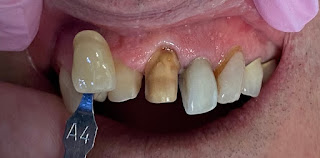

Should the material a crown is made from dictate the amount of reduction?

Image
 Traditionally dentists have been trained to provide a chamfer or shoulder of 1 mm if possible. For smaller teeth .75 mm might have been used in order to not overly weaken the remaining tooth structure. This amount of reduction was advisable because most of the crowns made were porcelain fused to metal crowns that needed this reduction to make room for both metal and porcelain materials. With the advent of adhesive dentistry, some dentists (myself included) used more minimal reduction strategies for anterior teeth. After all, only a .5 mm chamfer or shoulder is necessary to fabricate bonded feldspathic crowns. More reduction was needed where the restoration would be in occlusion, but at the neck of the prep restorative material is not under as much stress and shouldn't need as much thickness.While esthetics can sometimes dictate a greater reduction (especially in the case of a darker stump shade), most of the time .5-.75 reduction is all that is necessary.   Another ...

How does your garden grow?

Image
 This is a somewhat strange tittle for a dental blog post, but more and more, when I examine my patients mouths I often feel like a gardener examining the flowering plants and shrubs that he has taken care of for years. My patients mouths, especially those who follow my recommendations have done quite well and even though many are over 70, they have retained most or all of their teeth. Alright, I should admit that I am fortunate to be practicing in Manhattan and many of my patients are relatively affluent compared to others. They feel like they can afford to come in frequently for recall and restore their teeth according to my recommendations.  Although treating caries and performing restorative dental procedures are part of my practice, education and preventive dentistry play a larger role in maintaining my patients oral health. I encourage all my patients to use an electric tooth brush, clean interproximally and have at least two cleanings per year. For many patients oral ...

Can Electric Toothbrushes cause Vertigo?

Image
When my cousin came in for a cleaning she told me that she stopped using her electric tooth brush because she was experiencing vertigo. Her husband, a neurologist told her to stop using her electric toothbrush because it might be aggravating her vertigo (BPPV). By the time I saw her for her cleaning she had been using a manual brush for several months and her plaque control and gingivitis was worse than when she had been using her electric brush.  I did a little research on BPPV and one study found that of the patients who had BPPV 12% reported dizzyness after using their electric toothbrushes... Huh? The study did not conclude that people with BPPV should refrain from using electric toothbrushes  since " The results align with some publications demonstrating that vibrations in the head and neck area from the use of an electric toothbrush can initiate dizziness; however, it does not appear that this modality of vibration is significant for inducing recurrent BPPV. " Whi...

Food impaction and its role in making teeth prone to periodontal disease and interproximal decay?

Image
 While all dentists strive to do fillings with good interproximal contact areas, it still is not uncommon for fillings to end up with less than ideal contact areas that can allow food to get stuck in between teeth that . While flossing can remove this food, sometimes the food gets lodged in the gingival sulcus that contact a tooth and this can lead to recurrent decay or periodontal bone loss. One of the most frequent complaints I hear from new patients involve food getting stuck between teeth. Sometimes the solution is replacing some of their fillings since redoing them can eliminate this problem. In some situations, where significant tooth structure is missing in the restored tooth, a crown maybe the best solution. Proper contacts are not that difficult to achieve , especially if the dentist uses a contoured metal band in conjunction with a V-3 ring ( a spring that pushes teeth apart and helps adapt the contoured band). Even when using this system, care must be taken to ensur...

Best strategy for Senior dental care?

Image
  The New York Times has recently published an article titled " On Medicare and Need Dental Work? Beware a Big Bill" . The article pointed out correctly that standard Medicare plans don't cover most dental procedures unless they are related to the treatment of an ongoing medical problem. It also correctly explained that Medicare Advantage policies may cover some dentistry but they max out quickly if the patient the type of significant expenses involved with more extensive treatment plans involving implants.  The truth is that seniors are often on fixed incomes and are loath to spend what savings they have on significant dental plans. I have some personal experience with this subject since a very high percentage of my patients are over 65 and most of those are either retired or planning on retiring in the near future. While I participate in two dental plans ( Cigna PPO & Delta Premier) most seniors who retire are uninsured.  They often complain about the cost of d...

The Roaring Twenties are back?

 One hundred years ago the world suffered through a pandemic and WW I at the same time. When they were over, people were ready to celebrate and afterwards the Roaring Twenties ensued. People were in the mood for conspicuous consumption and partying to celebrate.   I t was a period of economic prosperity with a distinctive cultural edge in the United States and Europe, particularly in major cities   ]  M ost of my patients have been vaccinated and have been staring at their teeth during numerous Zoom sessions over the last year and they are often ready to contemplate cosmetic dental procedures when they have returned to my office. Often they are not as concerned over the cost, since many have saved money be cause they haven't been entertaining, traveling or taking vacations during  the last year. Also some patients have delayed needed dental treatments during the pandemic but are ready to get started, now that they are vaccinated and the Pandemic seems to b...